Approaching the Pareto Frontier in University Life
This article explores Approaching the Pareto Frontier in University Life, covering the core findings, methodology, technical details, and practical lessons for security professionals.
“Why do academic depth and field experience feel like a trade-off ?
What should CTIS students actually optimize for ?
How do you discover where your real value is before it becomes too late ?”
Hi folks, today I want to talk about something I keep seeing around me at university. Moreover, I think it matters more than we usually admit: the balance between grades, career preparation, social life, and personal growth. Over the last few years, I have been involved in different environments such as student clubs, societies, bootcamps, and external university events. In almost every one of these spaces, I noticed a similar pattern. Some have extremely strong academically. They have 3.0+, 3.5+ GPAs, sometimes even higher. They take courses seriously, aim for master’s or PhD opportunities, and often believe that a strong academic record will open the right doors. What will happen everyone applies the Msc or Phd pipelines ? Even every student having 3+, 3.5+ CGPA ?
However, there is also a downside I have seen in some cases. Some of these academically successful students do not build a portfolio, do not write articles, do not create projects and sometimes do not even apply for jobs or internships because they are waiting for a more “proper” or “ideal” path. Furthermore, they have a tendency on well paid salaries + perks. Does that make everyone passing academy can literally fulfill what industry demands ? They may have excellent grades ,but little visible proof of what they can actually do outside the classroom.
On the other side, another student profile occurs where they have lack of / boundary GPA ,yet they are more active & social in their leisure time / attending events. They go to events, do sports, build friendships and relationships, join communities, and try to enjoy university life while they can. Their logic is also understandable: “We won’t be young forever.” That is why, they choose to live a more balanced, relaxed, and social life instead of chasing every possible grade point. However, they also still face internship / job hunting issues as competitive GPA people cope with that.
Honestly, I think both sides have valid points. Academic discipline always matters in every environment. So does enjoying life. A strong GPA can create opportunities, especially for post grad scenarios. However, real-world experience, networking, projects, blogs and communication skills also matter a lot in both job opportunities & research fields. At the same time, university is not only a place to collect grades; it is also one of the rare periods where we can explore ourselves, meet people, and grow in different directions. Plus, collaboration creates benefits upon assignments, mental condition and grades. It builds strong bounds between departmental more than university fellowship.
My question is not simply “Should I focus on GPA or social life?” Maybe the better question is:
How can we find the best trade off between them?
This is where the idea of the Pareto Frontier becomes useful in these kinds of decisions.
How do we approach each case?
“I have applied for three jobs & passed 6 interviews each and got 3 offers ,yet my CGPA is crumbling.”
At what point does it start to hurt you? Does it pull you below the 2.5 boundary? Does it close doors for master’s applications or scholarships later?
“My GPA is relatively great ,but I have nothing to show for recruiters.”
Then the uncomfortable question is: why didn’t you use some of your free time to build projects, explore the field you actually care about, or earn relevant certifications?
“I needed to rest in my free time.”
Fair. Rest matters. Burnout is real. But at the same time, we all have 24 hours in a day. Even a small, consistent amount of time can become a portfolio, a blog, a GitHub profile, or a certification path over time.
“I can’t do both assignments and job, there isn’t enough time.”
In my opinion, it is the hardest and worst scenario. Some students genuinely get stuck between academic pressure and work responsibilities. A proper company can reduce that pressure by giving reasonable tasks, flexible expectations and space to survive the semester. However, they are not isolated complaints. Moreover, they reflect a deeper assumption in how many students think about university. That is why, academic performance and industry relevance exist on a single axis, and moving toward one automatically means moving away from the other.
I think that assumption is wrong ,so it may be costing students years.

1. The Invisible Cost of Chasing Grades
Most students who obsess over their GPA are not making a bad decision instead, they are making an incomplete one. A strong academic record opens real doors in academia. Graduate university applications, scholarship eligibility, faculty recommendations. Nobody is arguing against that ,but the problem is not the GPA itself it is what gets quietly sacrificed in pursuit of it.
Four years of skipping club events, avoiding side projects, not writing anything publicly, not building a GitHub profile, not attending industry meetups, not sharing public blogs about related field, not reaching people from their industry none of this shows up on a transcript. It accumulates invisibly and these are only becomes visible the moment you sit down to apply for an internship or a job. What’s more, examples I gave are seem like ROI for long term not your current moments. That is when the recruiter opens your CV and sees a 3.7 GPA with nothing else behind it. No projects. No portfolio. No evidence of what you can actually do outside a controlled exam environment. The grade signals potential ,but not always. The empty CV signals that the potential was never exercised or they don’t deserve position / field or profession and you are not keen on the field you applied… The same gap appears on the other side. Academically strong students applying for research positions or MSc programs with no independent output, no write-ups, no contributions, no demonstrated curiosity beyond coursework find that grades alone are not sufficient evidence of research capability.
As a result,
GPA is one axis. The frontier requires two.
2. What the Pareto Frontier Actually Means
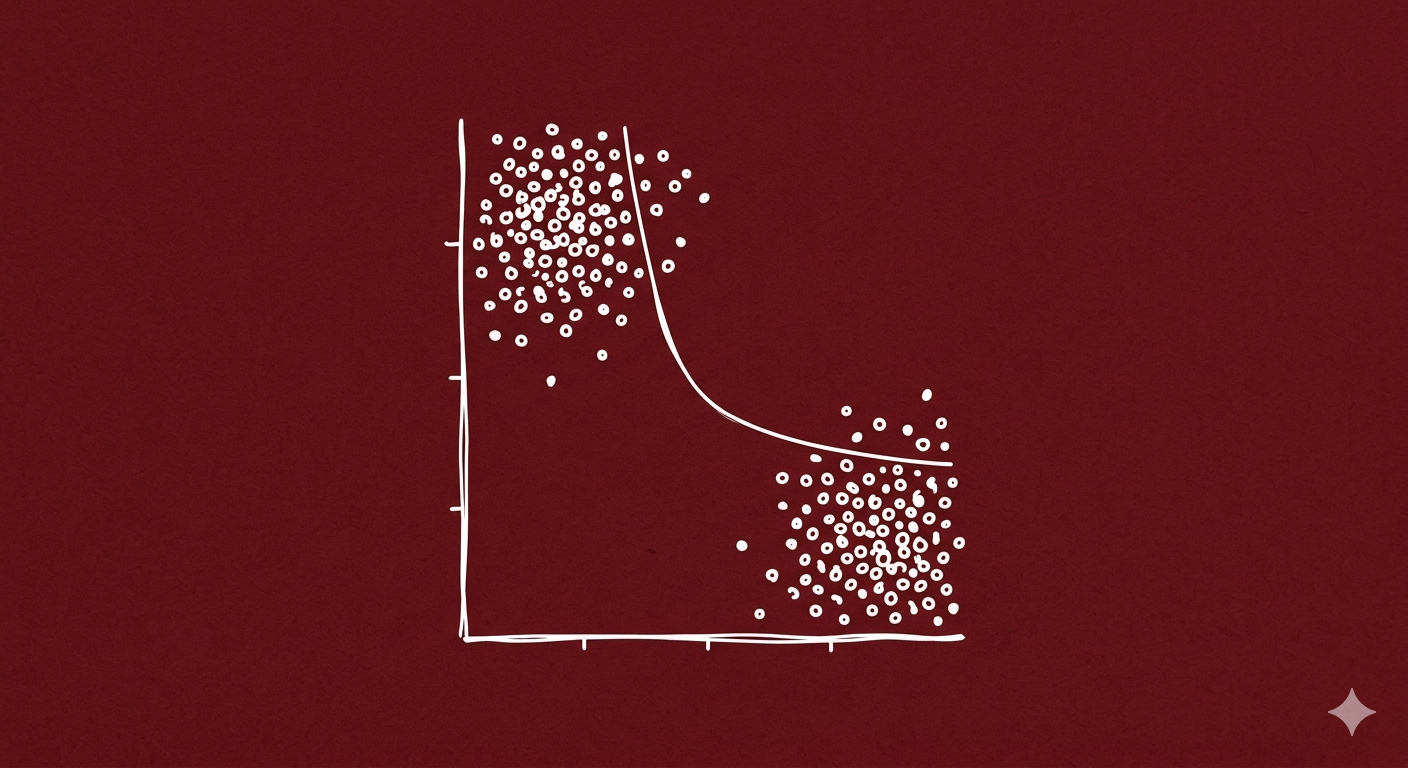
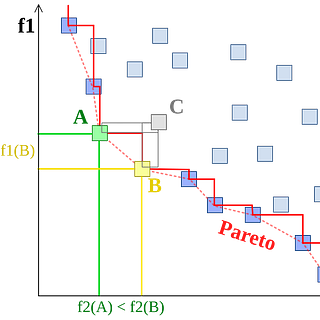
In multi-objective optimization, the Pareto frontier is the set of solutions where you cannot improve one objective without degrading another. Every point on the frontier is optimal in its own way ,so no strictly better option available.
You don’t need to know the math for this article :)
My intuition is such that Imagine a scatter plot.
X-axis: industry value (real skills, portfolio, network, employability).
Y-axis: academic value (knowledge depth, research output, credentials, faculty relationships).
Every activity you do as a student lands somewhere on this plot.
Most students cluster in one corner or the other. A few end up scattered in the middle meaning that doing okay on both ,yet doing greater at neither. The students who win are the ones who consistently find activities that score high on both axes simultaneously.
On the other hand, especially there are concrete trade offs, if you invest on real skills then your brain may fucked up ,so you can’t get anymore. If you attend events then you will not get higher grades you expect.
Finally…
Let me ask you attended event and met with superficial guys in your industry and contact through many social platforms and make impression on them by describing your current profession status what you can do ? How you can build such software projects ?, what are your true goals after graduation on your field ?
As a result, Y axis reduces ,yet you will get better on X axis.
Those activities are Pareto moves. they’re more common than most students realize.

3. The Suboptimal Zones
Before identifying the good moves, it would be nice to have naming the failure modes clearly and the profile worth aiming for.
The Pure Academician (STUCK PIPELINE)
CGPA: 3.5 – 4.0
Internship experience: none.
GitHub: empty. They know the material cold.
They can answer every exam question. Moreover, when a hiring manager asks what they’ve built, there’s silence and not in most cases ,but the demand is different in industry and academia. Hence, they must build projects, skillset, on demand skills about the job they applied. When a graduate school asks for evidence of independent research output, there’s nothing.
High on one axis, invisible on the other.
The Pure Sectoralist
Field based works, projects, blogs about the interested field, networking events, bootcamps, collaborating and publishing & developing tools with other university people.
CGPA: 2.0–3.0
No letters of recommendation worth anything for them. No depth in university tasks just exposure. They can talk about tools they’ve used but struggle to explain the fundamentals behind them. When the job market gets competitive or Msc, Phd becomes relevant, the foundation will not be there. However, money can unlock masters for them, if they made a lot of stuff in specific fields where their department does not include.
The Pareto Student
CGPA somewhere between 2.5 and 3.0 not obsessively optimized ,yet it is not neglected either.
- A GitHub with actual commits & published project / products.
- A blog with technical articles in related fields.
- At least one internship that produced something extensively documentable (getting greatly praising letter from company at the end of the CTIS310).
- They are not superhuman and their difference is selection of every parts in tasks and their responsibilities.
In conclusion, every major time investment generates value on both axes simultaneously. A course project becomes a GitHub repository. Plus, their internship produces a case study. Lastly, they become the frontier. In my sincere opinion, these guys are full of GENERALIST compared to others. Most of the above types have main focuses actually. Specialization does not work anymore, there should be something specific upon their profession, projects and work they have done. All suboptimal profiles have made a choice (often unconsciously) to optimize hard in one direction and treat the other as a write-off. The uncomfortable truth shall be in a competitive market, both get filtered out by different gatekeepers.

4. Pareto Moves: What They Look Like for a CTIS Student
A Pareto move is any activity that generates durable value on both axes. Here are concrete examples mapped directly to the CTIS curriculum.
CTIS 411 / 456 Senior Project: Open Source + GitHub + Paper
Most students treat their Senior Project as a graduation requirement ,but it does not have to be. A well-scoped project with a real problem, clean architecture and public documentation on GitHub becomes a portfolio anchor that outlasts the grade. A concrete blog article about what you have done as a team & personal and why it matters for you ? or what kind of problems did you encounter ? are great ways for you. If the problem is novel enough, it can become a workshop paper or a technical report. Same time investment, radically different downstream value.
CTIS 365 Applied Data Analysis: Independent Dataset Project → Blog Post / Academic Paper
Data analysis assignments give you the methodology. Apply that same methodology to a publicly available dataset you actually find interesting a social trend, a security dataset, an economic indicator. Publish the analysis as a blog post. It demonstrates that your skills transfer beyond coursework and creates a permanent, indexed record of your thinking. If I took again the course then it will be great to conduct analysis on Large Language Model Biases / Biased outputs to understand what kind of topics that LLM’s tend to produce such behavior ? or SIEM Logs Analysis can be great projectile stuff like that
CTIS 255 / 256 Frontend & Backend Development: Deployed Side Project → Portfolio Anchor -> Blog About What You Have Done (Tech Stack, The Purpose)
Building something for a grade and building something for the internet or interest are different things. Take the Serkan Hoca’s badass skills from him and ship something real even a small tool, a personal project, or an open source contribution. A live, deployed project signals execution ability in a way that a grade cannot. A great way of interview chats about the value you added your projects.
CTIS 290 / 310 Internship → Case Study → Written Artifact
An internship where you passively execute tasks and go home is only half the value. The other half is documentation. Write about what you encountered (sanitized and generalized if necessary) in a format that demonstrates your analytical thinking. A well-written case study is something you can reference in interviews, link to from your CV, and use as evidence of depth. The internship gives you the material; the writing is what makes it portable. Even you publish something workable around your skillset or personal tendency so that recruitment pipeline can understand your interests in profession.
The pattern across all of these is the same:
Extend the output of activities you are already doing.
You are not adding more work instead, you are changing the shape of the work.

5. The Diminishing Returns Trap
As all systems have edge cases or boundaries, in pareto frontier, it is too normal to encounter failure mode which is doing
“Too much of the same thing.”
Nobody will give you a medal when you vibe code or clean coded application over 50+ times. Moreover, in the offsec context, the appreciation of CVE procedures does not evaluate your value if you push too much. There is no diff people have 10+ CVE and 5 CVE in that sense. Yeah the experience matters in cyber fields ,but you already demonstrated what powerful you are in vulnerability research we know bro ! xD
In another sense, the tenth certification is not ten times more valuable than the first. The fifth internship at a similar company does not compound on the previous four the way the first one did. At some point, adding more of the same type of activity stops moving you along the frontier and starts leaving you in place busy ,yet not progressing. Therefore, it can be the diminishing returns trap. It’s seductive because the activities feels productive. You are constantly earning credentials. Moreover, you may build experience. On the other hand, your marginal value is approaching zero.
The alternative is building things. Maybe it can be shipped project and (even a small one) creates a different kind of evidence than a certification. It shows you can take an idea through design, implementation, and completion. Certifications tell a reader you passed a test ,so you have capacity like other people do. A project shows you can operate under uncertainty and produce something real, more original (maybe it may be produced another dev).
When you find yourself reaching for another certificate, ask: is this moving me forward or is it familiar enough to feel safe?
The frontier is not found by doing more of what you already know. It can be found by doing things that becomes uncomfortable at first precisely since they require both domains at once.

6. A Practical Checklist
Before committing significant time to any activity, run it through two questions:
What does this contribute to my academic profile?
(Knowledge depth, research output, faculty relationships, credentials that open Msc Phd doors)
What does this contribute to my industry profile?
(Real skills, portfolio artifacts, network, demonstrable output, Job Specific Domains)
If both answers are weak / vague that activity is frontier-adjacent at best. It’s not necessarily worthless ,but the academic path should not be your primary investment if you cannot reach at least 2.5 or slightly below it (if you have money then its ok).
If one answer is strong and the other is zero ,so you’re operating in a suboptimal zone. Can you reframe the activity to generate value on the neglected axis ? Often, this is possible mostly and it requires less additional effort than you’d expect.
If both answers are strong that’s a truly Pareto move…
The GPA vs. internship question assumes a trade-off that shall not have to exist. In my sincere opinion, the students who exit CTIS in the strongest position are not the ones who chose one side or the other. From my point of view, they are the ones who stopped thinking in terms of sides entirely.
The frontier always there. Most people just do not look for it.
Written for CTIS students who are figuring out how to make the most of four years.