CVE-2025-60506 | Stored Cross-Site Scripting (XSS) in Moodle PDF Annotator plugin (v1.5 release 9)

Date: 17-Oct-2025
Tags: Cybersecurity, responsible-disclosure, penetration-testing
Summary
- Vulnerability: Stored Cross-Site Scripting (XSS) in Moodle PDF Annotator plugin (
mod_pdfannotator) — Public Comments rendering. - CVE: CVE-2025-60506 (assigned)
- Discoverer: Onurcan Genç — Independent Security Researcher
- Tested environment: Bitnami Docker image for Moodle 4.x
- Plugin:
mod_pdfannotatorv1.5 (release 9, build2025090300) - Browser used during testing: Chrome (headless/visible)
Vulnerability Summary
The Public Comments feature in the PDF Annotator plugin fails to properly sanitize user-supplied input before rendering it inside the PDF viewer’s comment panel. A low-privileged authenticated user (e.g., Student) can inject HTML/JavaScript into the Public Comments field; that content is stored and later executed in the browsers of other users (Student, Teacher, Admin) when they open the annotated PDF.
Affected Component
/mod/pdfannotator/view.php/mod/pdfannotator/ajax.php
The vulnerable input is submitted via the Add Public Comment action; comments are loaded via AJAX and inserted into the PDF.js comment panel without adequate output encoding.
Attack Scenario (high level)
- Attacker (Student): Adds a Public Comment containing unescaped HTML/JS to an annotated PDF activity.
- Trigger: Another user opens the same annotated PDF activity. The stored comment is inserted into the DOM of the PDF viewer and the browser executes it.
- Result/Impact: Stored XSS execution in victim’s browser — possible impacts include session theft, forced actions in the victim session, UI/UX manipulation, or further chain attacks depending on context.
Important (safety): Publicly published PoC examples below use non-exfiltrative payloads (e.g., alert() or visible DOM markers). Do not publish or use payloads that exfiltrate cookies, credentials or other secrets in public artifacts.Technical Analysis (quick)
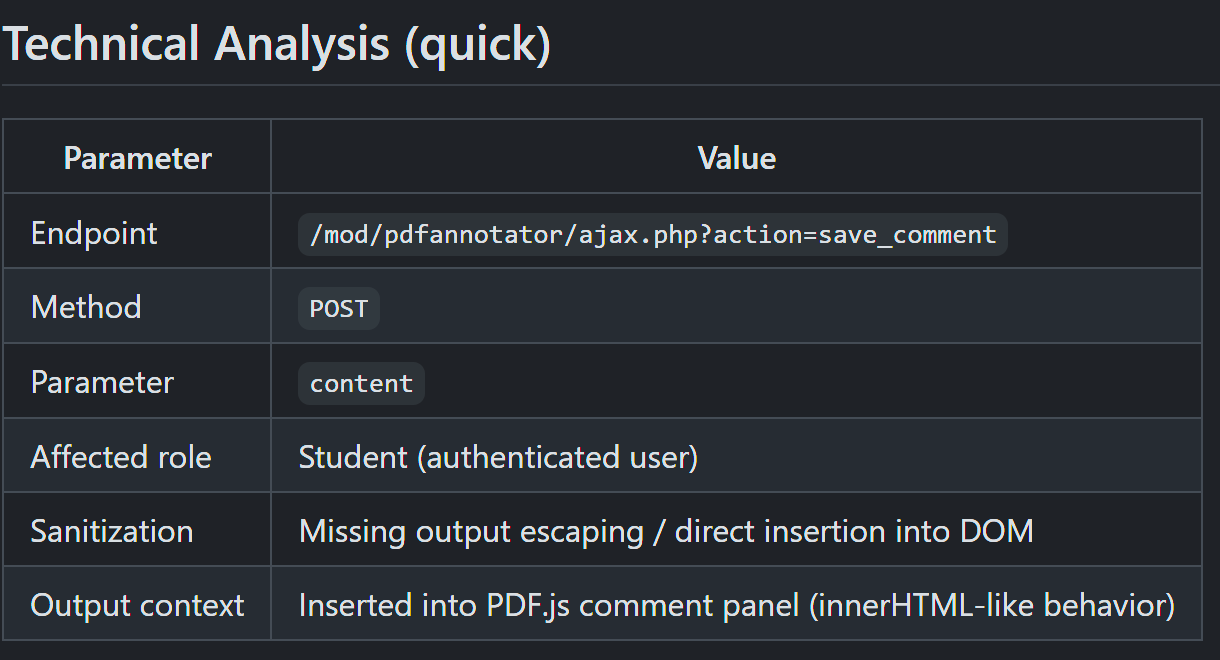
Illustrative request (do not publish real cookies):
POST /mod/pdfannotator/ajax.php?action=save_comment&id=3 HTTP/1.1 Host: 127.0.0.1:8080 Content-Type: application/x-www-form-urlencoded Cookie: MoodleSession=REDACTED
content=<script>alert('XSS-POC - CVE-2025-60506')</script>&userid=8&pdfid=5
Expected server response example (JSON):
{"status":"success","message":"Comment saved successfully"}
Proof of Concept
Create activity with Moodle Admin or Teacher assigned with correlated course.
Select PDFAnnotator
As a student I initially placed a shape to apply comment. After that vector to bypass JS tag ->
Click on comment part
Add any comment consisting
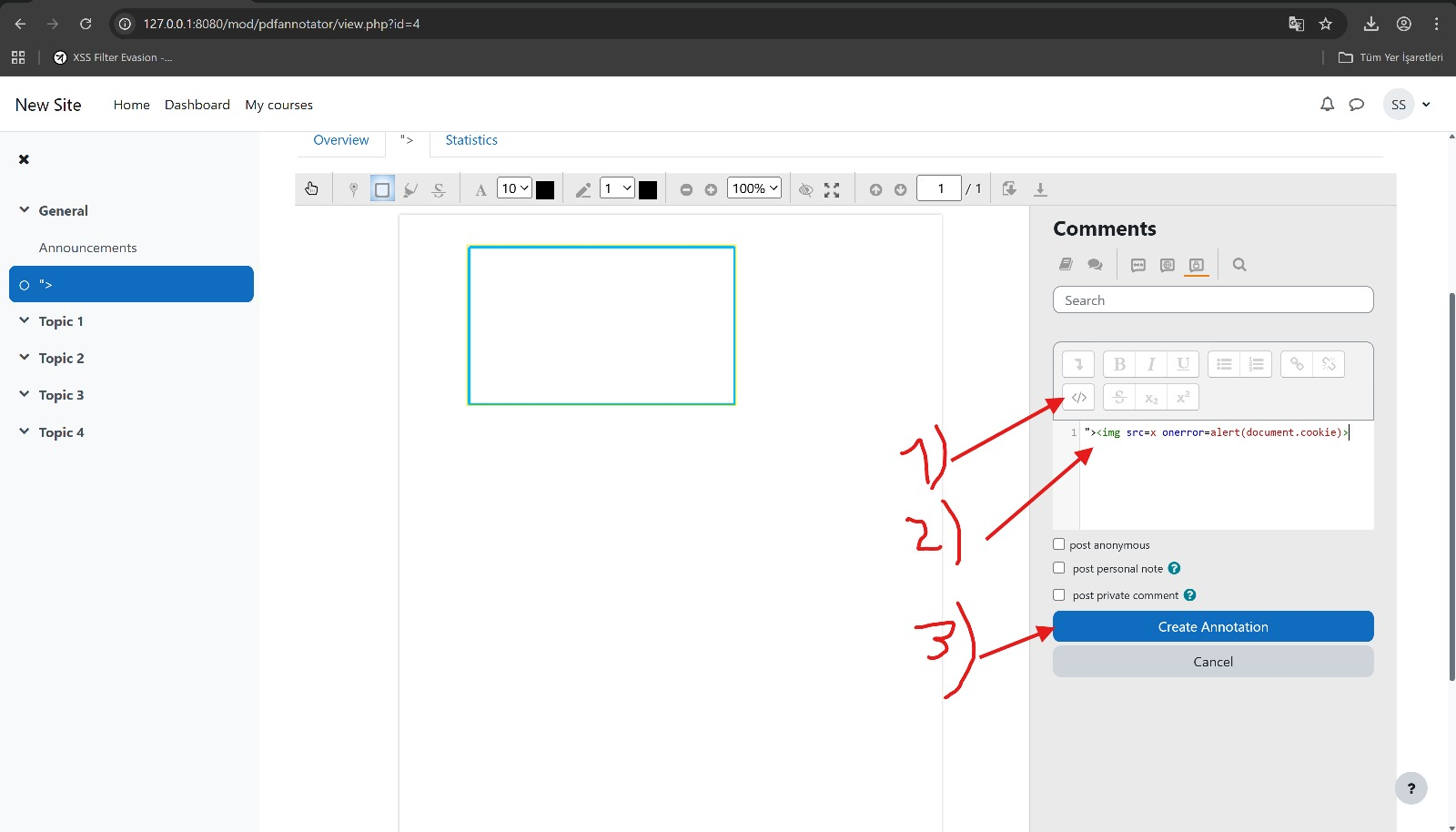
payload as below:
Create annotation refresh page and then switch to admin user.
As an admin user or teacher you can see the direct effect of Stored XSS via PDF handler.
CVSS Scoring (base metrics and rationale)
Recommended (based on testing that shows payload executes in Student, Teacher and Admin browser contexts):
- Vector:
CVSS:3.1/AV:N/AC:L/PR:L/UI:R/S:C/C:H/I:H/A:L - Base Score (approx): 8.9 (High)
- Rationale:
- AV:N (Network): Attackable over the network (web).
- AC:L (Low): Exploit requires no special conditions — a single comment submission triggers execution.
- PR:L (Low): Attacker needs a low-privileged authenticated Student account.
- UI:R (Required): Another user must view the annotated PDF to trigger the payload.
- S:C (Scope: Changed): The payload executes in Teacher and Admin browser contexts (higher-privilege sessions were observed), which means the impact crosses the vulnerable component's security boundary and can be chained to admin-scoped actions.
- C:H / I:H / A:L: Confidentiality and integrity impacts are high (cookie/session or admin actions possible if chained); availability impact is low.