Applying Ethical Theories in Responsible Disclosure Program

“CTIS363 case study for responsible disclosure, institutional accountability, professional moral rules examined through five ethical norms.”
Introduction
Responsible disclosures as its innate structure clarifies “A great ethics” “A Full Moral Activity”. However, frequently, it sits at one of the most uncomfortable intersections in information security. Whether it is a good will or an action attempted to protect a system as soon as possible or immediately, it may understood completely wrong in culture to culture. When a security researcher discovers a critical flaw in a live system, production or test environment, his or her decision to report it initiates a chain of moral choices that extend far beyond the technical finding itself. Vulnerability are somehow reveals itself whenever you took in place your attention, agency or motivation in advance. Indeed, the crucial questions must be such that
Who should be told ?
Through which channels ?
How long should the researcher wait for a response ?
Moreover, perhaps, most importantly what happens when the authority / organization designed to coordinate the process fail to do their part ?
From my point of view, these are not hypothetical questions. Across the global cyber ecosystem, researchers regularly cope with situations in which they follow every established rule of responsible disclosure and still encounter organizational / institutional silence, communication bottlenecks or unprofessional silent awaiting responses for holding the system accountable.

My article presents an anonymized scenarios and cases from both CTIS 363 Ethical and Social Issues in Information Systems. Focusing on responsible disclosure attempts ,but approaching in philosophical theories. The case is analyzed through the five workable ethical theories identified by Quinn: Kantianism, Act Utilitarianism, Rule Utilitarianism, Social Contract Theory, and Virtue Ethics. The goal is not to assign blame to any specific party, people or individual ,but to use the tools of ethical reasoning to examine a structural problem that affects the entire offensive / defensive security research community.
The Scenario
A security researcher discovers a critical vulnerability in commercially deployed web application running live. Assume that the flaw allows complete application takeover. I mean that the flaw allows admin access to content alteration of company. Following the responsible disclosure practices, the researcher reports the vulnerability to the coordinating authority responsible for managing vulnerability records in their jurisdiction. The authority acknowledges the report and assigns a tracking identifier. However, over the following months, the record is never published although the application has been under complete risk due to the nature of the vulnerability. The researcher sends a lot of follow up communications, all written in professional and sincere language. Moreover, (s)he did not receive substantive written response. The normal condition for all authorities is that publication will occur only after the vendor patches the software. The rule is a complete process ,yet contradicts the established international program rules (Social Contract Theory), which explicitly require that publication must not depend on vendor remediation.
Let’s assume, after more than 90+ days of inaction, the researcher considers the official dispute mechanism provided by the root body that oversees the responsible disclosure program. The root body reviews the case, contacts the related body reiterates the applicable rules and somehow publishes the vulnerability record in one day.
Now, the question we must ask is that ourselves is this concept:
Did the researcher do the right thing according to regarding theories?
Was the escalation morally justified ?
What does the silence of the coordinating body tell us about the ethics of the system itself ?
Let us walk through each ethical theory aligning the scenario:
Kantian Analysis
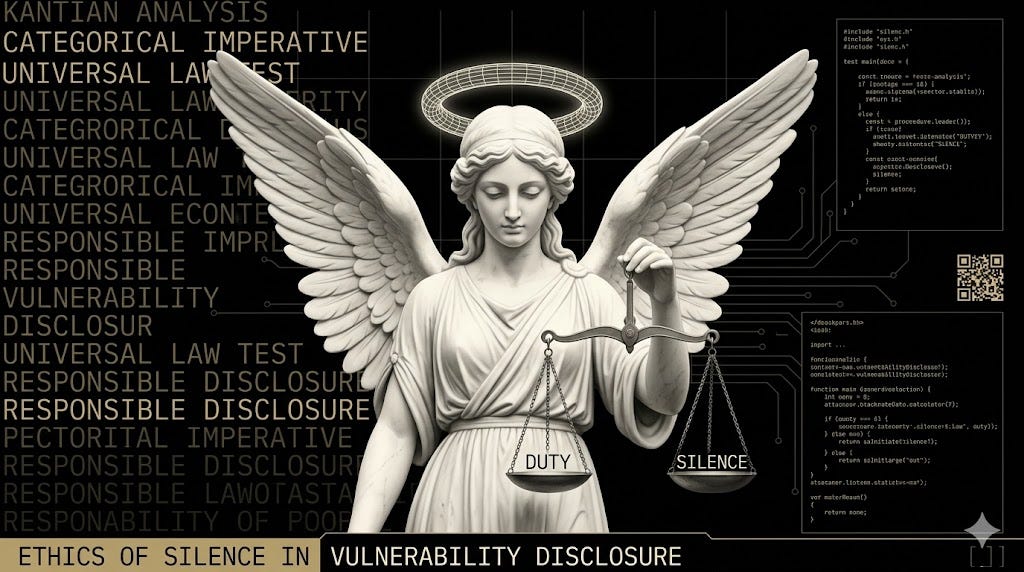
Kant tells us to look at the motive instead of the consequences. The question should not be “what happened after the escalation ?” ,but “why did the researcher escalate in the first place ?”.
Majority of the researchers approach straightforwardly in such case when an authority fails to fulfill its documented obligations after repeated professional attempts at communication, escalation through official is the correct course of action.
Apply the Categorical Imperative. Kant explains two rule upon that part depending on the case, situation select and apply accordingly:
First Formulation: Universal Law Test
Elaborating the condition scope more generalise & wider.
Could we want every researcher in the world to follow such rule ?
If every researcher escalated every responsible disclosure attempt when authorities failed to act for 90+ days ,so what would happen ?
The responsible disclosure system would become more accountable. Then it becomes reliable towards public & safety. Public always matters and authorities would be incentivized to respond in a timely manner. Vulnerability records would be published in a faster manner resulting protection of the public safety. The system does not break under universalization instead it will become more stronger.
In academic basis, the principle passes the test.
Second Formulation: Respect for Persons
Throughout the entire process, the researcher treated the authority as a rational agent normally. Therefore, it is acceptable to say that every communication was respectful. The escalation was not personal and it was procedural as usual. If the researcher did not publicly shame anyone, did not leak the vulnerability to the media or did not exploit the flaw. (S)he basically said once
“These are the rules. They are not being followed. I am using the mechanism designed for this exact situation.”
All in all, the condition is the very introductoring a treating mechanism others as ends, not merely as means. Keep an eye on the authorites’ behavior upon that progress:
By ignoring multiple professional communications attempts over 90+ days, the authority treated the researcher merely as a means, an input to be processed when convenient not a person deserving of acknowledgment and response. From Kant’s perspective, this is a complete failure of duty.
Kantian Verdict approaches that the researcher acted from pure duty. The authority did not.
Act Utilitarian Analysis
Act Utilitarianism does happines over population. Mainly asks that looking at this specific action in this specific moment,
“Did the vulnerability escalation progress produce more total happiness or more total harm ?”
Let us consider every probability in advance:
What Public Response ?
The clients of the vulnerable application benefits completely. A critical vulnerability has been documented then system administrators can take protective controls & measures. The risk of abuse of the vulnerability decreases significantly not totally ,so it is the largest positive consequence and affects the most people.
The software vendor experiences discomfort. The product consisting a documented flaw ,but discomfort is still temporary and the vendor is now forced to actually fix the issue rather than ignoring it indefinitely. In long term, a patched product serves the vendor’s reputation and their customers’ safety.
The coordinating authority faces internal accountability. Someone (internal team/researcher) must explain why the case was open for 90+ days without action. It is completely uncomfortable. I agree with the case ,yet is this harm ? Let’s ask another way, is this the natural consequence of not fulfilling a documented obligation ? There is an important difference between “being harmed” and “being held accountable.”
The researcher part successfully fullfilled the desired outcome in both ethical landscape and socially. The vulnerability was published ,yet the researcher also invested significant time and emotional energy over months of silence. The personal cost is real and even without considering any career consequences. In conclusion, future researchers may tend to do same action. The most crucial variable is that if the outcome demonstrates that escalation works then the official dispute mechanism actually produces results. Future researchers are encouraged to participate in responsible disclosure. The system gains credibility and a massive positive utility in place.
Act Utilitarian Verdict: The escalation produced significant net positive utility. The public is safer, the system is more credible, and future researchers see that the process works.
In academic border, RULE A passes the overall observance

Rule Utilitarian Analysis
Rule Utilitarianism enlarges the scope of the context. It does not ask “was this specific escalation good ?” ,but “if we made this a universal rule, would the world be better off ?”
Two rules compete:
Rule A: Researchers should escalate through official dispute mechanisms when coordinating authorities fail to respond within a reasonable timeframe.
Rule B: Researchers should wait indefinitely and accept institutional silence, regardless of how long it lasts.
If everyone follows Rule A: Coordinating authorities encounter consistent accountability. They develop internal processes for timely response. The disclosure ecosystem becomes reliable and trustworthy. More researchers participate because they know the system works. Vulnerabilities are published and remediated faster. The internet becomes safer.
If everyone follows Rule B: Authorities face zero reults for inaction. Response times getting larger from months to never. Researchers lose faith in the formal system and either publish vulnerabilities independently (LEGAL RISKS & public risk increments) or stay silent entirely (dangerous for public safety). The formal disclosure framework becomes a bureaucratic dead letter that nobody trusts.
The comparison is not close. Rule A builds a functioning ecosystem. On the contrary, Rule B ruins it. However, this is where it gets interesting, the authority’s implicit rule also deserves examination. The behavior suggests a rule like: “We will publish vulnerability records only when we choose to, on our own timeline, regardless of documented obligations.” If universalized, this rule means no researcher can ever rely on the process. Why would anyone report through official channels if the response is silence ?
Rule Utilitarian Verdict explains the researcher’s rule is clearly superior. The authority’s implicit rule is self defeating.
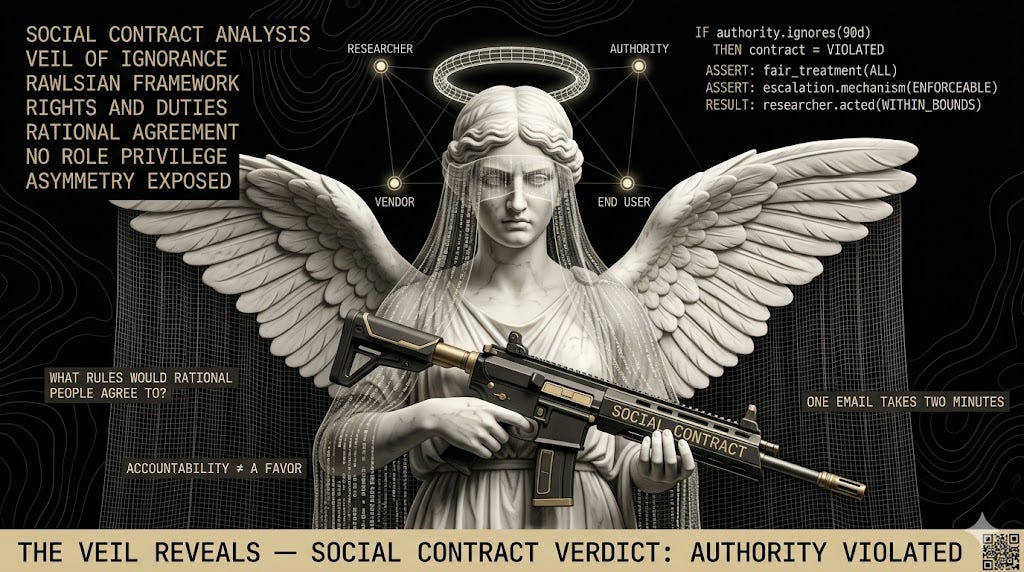
Social Contract Analysis
Social Contract Theory mostly asks such questions:
What rules would rational people agree to if they were designing the system from scratch, not knowing what role they would occupy ?
The answer depicting where the Veil of Ignorance becomes powerful. Imagine you do not know if you are the researcher, the authority employee, the software vendor or an end user of the vulnerable application. You must choose the rules of the disclosure system without knowing which side of it you will be on. You can’t solely promise on the title “researcher”, “employee”, skin color, gender, intellectual beliefs, religion and so on…
Behind the veil, a rational ethical hacker would want to prompt acknowledgment of vulnerability reports just because they might be the ethical researcher. Timely publication of vulnerability records, they might be the end user. Applying clear and enforceable escalation mechanisms since any part of the system might fail. Furthermore, it suitable that fair treatment of all parties. Therefore, they could be anyone. There is no rational person behind the Veil of Ignorance would choose a rule that says: “The coordinating authority may ignore communications indefinitely and the researcher has no meaningful recourse.” This rule only benefits those who already hold power. It is the exact kind of asymmetry that Rawls designed the Veil of Ignorance to expose.
What about rights and duties (the responsibilities of agent) ? The researcher has a right to expect timely processing of a legitimate vulnerability report so as to ensure the risk become minimized. The authority has a duty to respond within a reasonable timeframe, even if only to say “we are working on it.”. When the authority fails this duty, the researcher has a right to seek remedy through the established dispute mechanism introduced by main body. Think about it this way: a single acknowledgment email one sentence confirming the case is under review takes two minutes to write upon your request. A lot of follow-up communications over 90+ days without a single substantive written response considers that it is not a workload problem. It is an merit or accountability problem. Even the most overwhelmed bodies can send a brief status update. The failure to do so reflects is not resource constraints ,but also the absence of a culture in which responding to researchers is understood as an obligation rather than a favor.
Social Contract Verdict: The researcher acted within the bounds of a fair agreement. The authority violated the social contract.
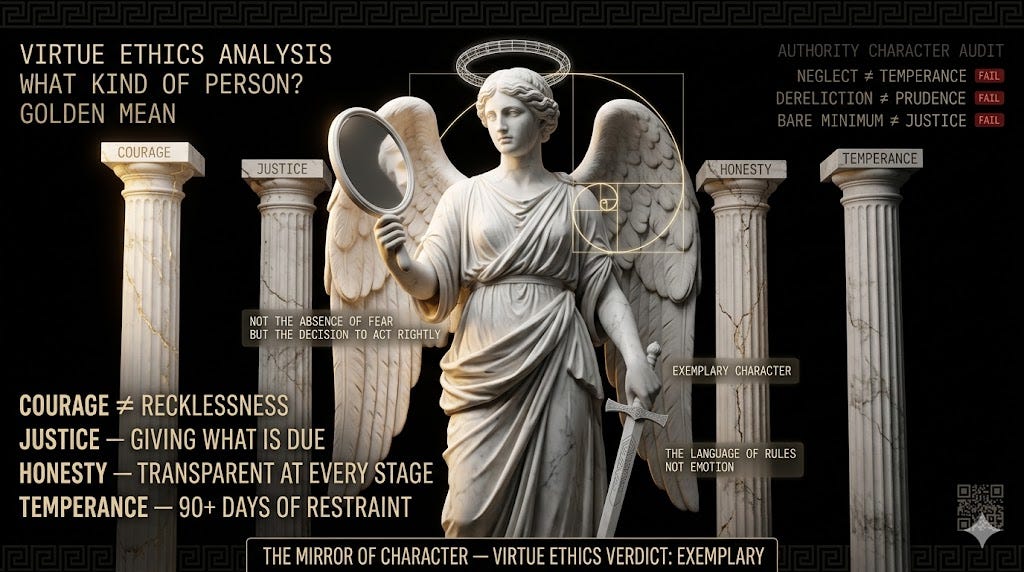
Virtue Ethics Analysis
In Virtue Ethics, we do not ask such question “was the action right ?” It asks “what kind of person performed this action ?”
Let us examine the researcher’s character through the classical virtues.
Courage: The Golden Mean between cowardice and recklessness. The researcher faced a significant power asymmetry in case. Moreover, one individual against an established authority ,so cowardice would have been to give up after the first month of silence. Recklessness would have been to publish the vulnerability publicly bypassing the formal process entirely. The researcher chose neither. Instead of doing such an unethical channels, (s)he persisted through professional channels and exhausted every reasonable avenue of communication and only then used the designated escalation mechanism. The form of courage in its truest form. It is not the absence of fear ,yet the decision to act rightly despite the imbalance of power.
Justice: Behaving others what they are due. The researcher did not seek revenge, publicity, or personal gain. The request was simple and fair, fulfilling the documented obligations of the responsible disclosure program. Then nothing more, nothing less.
Honesty: The researcher was transparent at every stage. The vulnerability was reported through proper channels. Evidence was provided openly. Follow ups were professional (no slang or insulting words sentences). The escalation was conducted through the official mechanism not through back channels, leaks, or darkweb environment. There was no deception, no exaggeration, no manipulation.
Temperance: Moderation and self-restraint describes the condition where researcher waits over 90+ days and could have gone public. Could have posted the vulnerability details on social media ? Could have written angry emails ? Instead, every single communication was measured polite, and professional. Even the final escalation was written in the language of rules and procedures which aligns the main body.
As a result, the condition contrasts with the authority’s behavior as character what we call in ethic “Virtue”. Ignoring repetitive professional communication attempts are not temperance instead it reflects neglect. Failing to fulfill documented obligations cannot acceptable. Therefore, it is negligence. Additionally, responding to accountability only when forced by a higher authority sounds like disciplining.
Virtue Ethics Verdict covered and demonstrated exemplary character. The authority’s conduct fell short of the virtues expected of an institution entrusted with public safety.
Conclusion
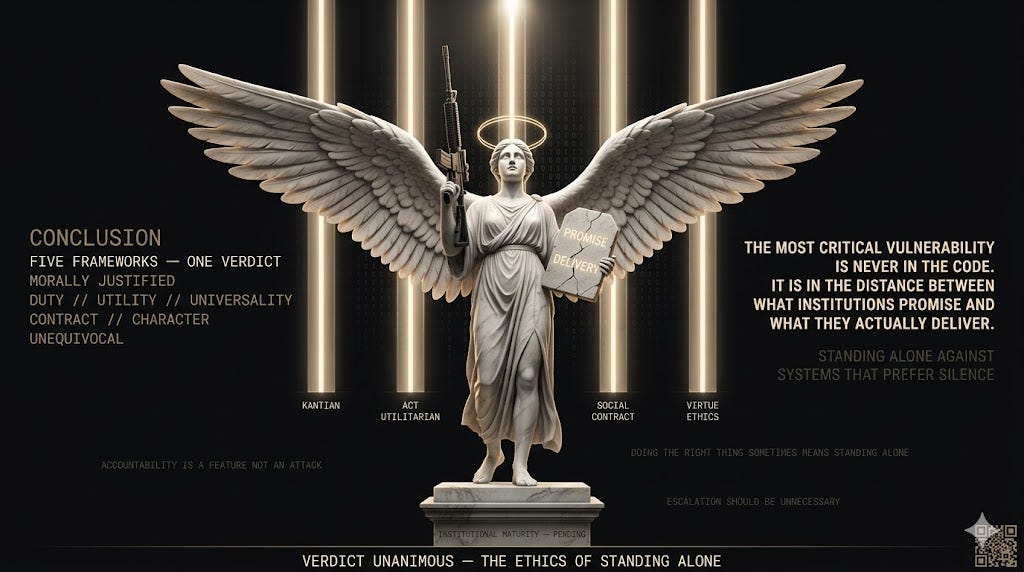
The ethical analysis presented in my article is predictable. I demonstrated and clarified five independent workable ethical frameworks all conclude that the researcher’s escalation was morally justified. The researcher acted from duty, produced positive outcomes, followed a universally beneficial rule, respected the social contract and analyzed virtuous character. The more difficult question and the one that no single ethical theory can resolve alone is how we build mechanisms that are mature enough to make escalation unnecessary ultimately. Organizations where a researcher’s first report receives a timely acknowledgment. Where vulnerability records are processed according to documented timelines. Where accountability is understood not as an attack ,yet as a feature of a well-functioning system.
Until that organizational maturity is achieved across the global ecosystem, security researchers will continue to face the uncomfortable reality that doing the right thing sometimes means standing alone against systems that would prefer silence. The most critical vulnerability in cyber world is never in the code. It is in the distance between what people promise and what they actually deliver when someone holds them accountable. I wanted such an case analysis to be prepared as part of academic reflections for CTIS 363: Ethical and Social Issues in Information Systems at Bilkent University. The scenario presented is randomly generated and serves as a vehicle for ethical analysis not totally as a factual claim about any specific institution, individual, or organization.